Emotion Research
Posttraumatic Growth
In collaboration with Cambridge University and Professor Peter Fonagy at University College London and the Anna Freud Institute, we found across multiple measures that empathy is heighted in adults following a childhood trauma (Greenberg et al., 2018). The study was limited in that it relied on self-report and retrospective data, however provides initial support to the counterintuitive hypothesis that childhood trauma can lead to increased empathy. Our next steps in research is to employ longitudinal and performance measures. Our hypothesis is that childhood trauma and increased empathy in adulthood is mediated by several factors including meaning-making experiences (e.g., via music or spiritual practices), attachment, and social support.
Emotion Regulation and Mentalization
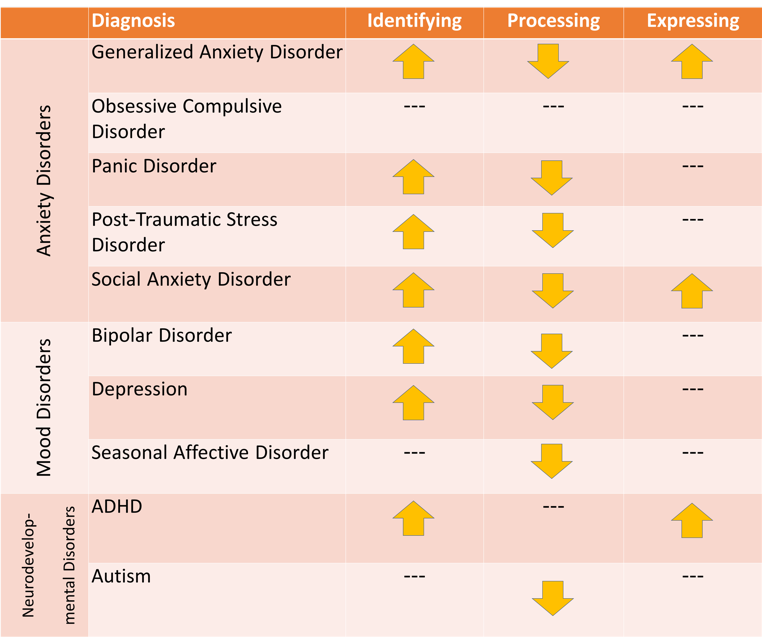
Trauma does not always result in post traumatic growth and sometimes can lead to maladaptive symptomatology including difficulties with emotion regulation. My interest in trauma and cognitive empathy (i.e. mentalization) led me to develop an emotion regulation scale based on mentalization in collaboration with Professor Elliot Jurist at City University of New York (Greenberg et al., 2017). The scale offers a varied perspective to commonly used measures. The 60-item Mentalized Affectivity Scale (MAS) measures three dimensions: Identifying, Processing, and Expressing and is currently being translated by separate research labs into Spanish, German, Turkish, and Korean.
- Identifying is the ability identify emotions and to reflect on the factors that influence them (e.g. childhood events)
- Processing is ability to modulate and distinguish complex emotions
- Expressing is the tendency to express emotions outwardly or inwardly
These three dimensions are linked to clinical diagnoses, with anxiety, mood, and personality disorders showing a profile of high Identifying and low Processing. As shorter 12-item version has been developed and has been administered to a clients at community psychotherapy clinic.