Music Research
Music Perception and Preferences
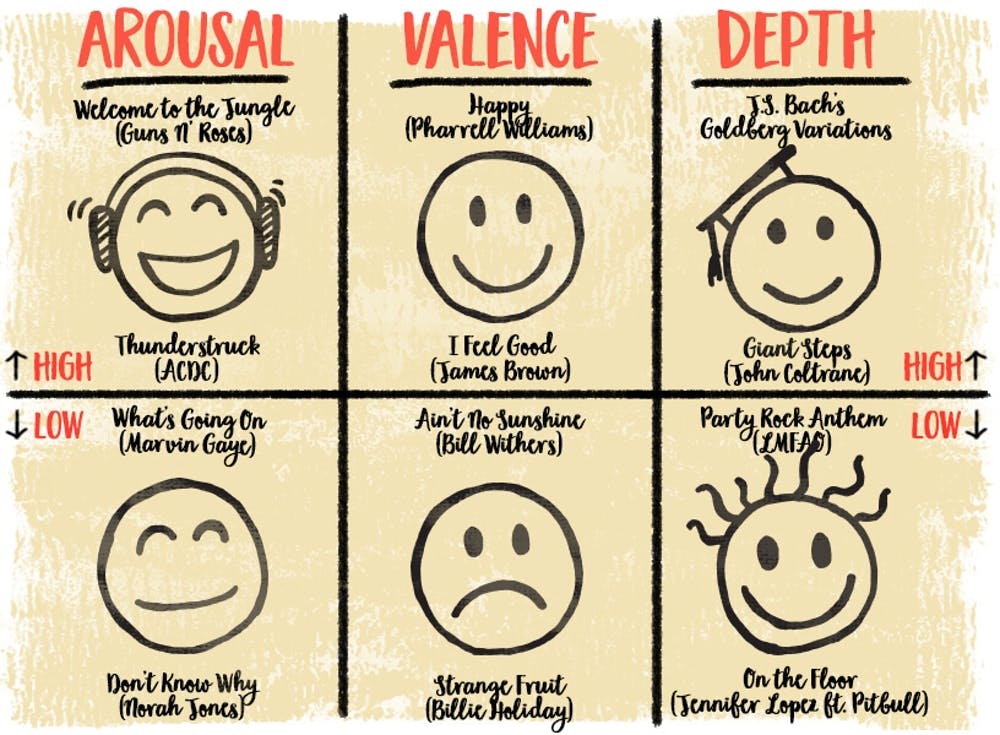
My first line of research examines music perception and preferences through personality and social psychology. Here, the conceptual framework guiding my work draws from interactionist approaches (Buss, 1987; Swann, Rentfrow, & Guinn, 2002) positing that people seek environments that reinforce traits and fulfill psychological needs. One way to observe this phenomenon is through the associations between music preferences and personality. Prior research on this topic, however, has used genre-based measures to assess musical preferences, which present serious limitations (e.g., illusive definitions that are socially driven). Therefore, I developed a behavioral method to assess preferences at the level of musical features based on human perception (e.g., sonic attributes including instrumentation, tempo, percussiveness and psychological/emotional attributes including sad, joyful, deep). There was a multiple of features to explore so used data reduction techniques to better conceptualize them. I found that music features can be organized into three basic, but robust dimensions (Arousal, Valence, and Depth), and that preferences for these dimensions reflect personality traits as conceptualized by the Big Five model of personality (Greenberg et al., 2016). The AVD model has since been replicated using mixed methods and cross-cultural samples (Fricke & Herzberg, 2017). Furthermore, we replicated the AVD model using computer extraction methodologies finding that the computer extraction of musical features mirrors the human perception of them (Fricke, Greenberg, Rentfrow, & Herzberg, 2018).The associations between music preferences and personality are robust and since the 2016 study, I have gathered evidence to evaluate the generalizability of the results across assessment methods and cultures. Specifically, using ecological valid data from digital footprints on Facebook and a machine learning approach, we showed that musical preferences can be as accurate at predicting personality as a coworker (Nave et al., 2018).

Musical Ability and Genius
My work has extended beyond music preferences and has investigated personality associations with attentive listening styles and musical abilities (Greenberg & Rentfrow, 2015; Greenberg, Müllensiephen, Lamb, & Rentfrow, 2015). For the latter, we used performance tasks that included an adaptation of Iverson & Patel’s (2008) Beat Alignment Test (BAT) and an established memory paradigm (Halpern, Bartlett, & Dowling, 1995) to measure melody memory. We found that the personality trait Openness was the strongest and most consistent predictor of musical ability. The findings replicated in non-musicians, suggesting that people high in Openness may have musical ability even if they never played an instrument. We also observed small effects of substance use including alcohol and recreational drug use. In an extension, I studied the personality traits of musical and creative geniuses both living and deceased (e.g., John Coltrane), showing that Openness is the strongest trait associated with genius across artistic and academic disciplines (McCrae & Greenberg, 2014).
Cognition
Personality only focuses on certain aspects of musical behavior, but there are many other aspects that are important and deserve careful attention. A different model is one focused more on cognition: the empathizing-systemizing (E-S) theory. E-S theory suggests that individuals can be classified on the basis of two dimensions. Empathy, defined as the ability to recognize another person’s mental state (‘cognitive empathy’) and the drive to respond to it with an appropriate emotion (‘affective empathy’), and systemizing, defined as the drive to analyze or build a rule-based system. In 2015, I proposed that though E-S theory has been used to understand typical sex differences, occupation, and learning styles, it can also be used to study important aspects of musical behavior, including perception, cognition, preferences, performance, and ability (Greenberg, Rentfrow, & Baron-Cohen, 2015). In what has become one of PLoS ONE’s most viewed articles, I led a study showing that empathy by itself predicts music preferences beyond demographic and personality traits, and that music preferences are differentiated by E-S ‘brain types’ (Greenberg et al., 2015).
Social Perception and Conflict
In an effort to learn about how music informs social perception, I investigated how social stereotypes are formed on the basis of musical cues (Greenberg & Rentfrow, 2017). Results showed that based on musical stimuli, people generate stereotypes and share agreement about the personality characteristics of prototypical music fans of specific features in music. These findings have led me to hypothesize that it is possible to change social behavior and perception on the basis of musical information and performance—particularly cognitive empathy (‘theory of mind’, mentalization) (Greenberg, Rentfrow, & Baron-Cohen, 2015). To test this, I measured participants’ ‘theory of mind’ using a performance task (The Reading the Mind in the Eyes Test: RMET) and administered a randomly selected song to them. Afterwards, participants completed the second half of the RMET. Consistent with our hypothesis, results showed that slower and more mellow ambient music was associated with increased ‘theory of mind’.
Given that social perception is embedded within musical perception, I have begun to investigate the role of music in conflict zones and societies in conflict. In 2018, I received an award from the Daniel Turnberg Fellowship of the Academy of Medical Sciences to conduct a social science and genetic study of the Israeli-Palestinian Choir in Jerusalem. The choir consists of an equal number of Israeli and Palestinian high school students. At the beginning of the academic year and at several points throughout, each of the students will complete a battery of assessments that assess psychological traits, stereotypes, prejudices, and attitudes. We hypothesize that increases in empathy may change the initial perceptions of outgroup members and have them become part of an in-group via shared musical dialogue and experience.
Clinical Science and Music Therapy
My clinical line of research examines how musical behavior is linked to diagnoses and the effectiveness of music-centered treatments. I am currently leading a study on the effectiveness of music therapy treatment for children with autism. In collaboration with the Center for Neurology and Neurological Health in New Jersey, we are testing five predictions based on pre-existing data.
There is evidence that music therapy is effective for individuals with posttraumatic stress disorder. We have found that typically developing adults with childhood trauma listen to music with heightened emotional engagement (Greenberg & Rentfrow, 2015). The type of trauma experienced also appears to have an impact on music listening as those who lost a friend or family member in childhood have elevated social engagement with music, suggesting that they use music to fill the void of the loss. Recently, a graduate student I supervised extended this research and found that adults with childhood trauma use different emotion regulation strategies for listening to music that is moderated by sex and personality traits (Rosenberg, Lamb & Greenberg, under review at Journal of Traumatic Stress).
Most recently, I am conducting research with a not-for-profit organization in Philadelphia, PA that provides after-school music education to middle school and high school students, all of whom are from minority and low SES backgrounds (average family income is under $20,000) and have experienced significant trauma. I am testing the role of music education in increasing academic achievement and mental health among the youth
Some More Projects
Big Data
In 2015, I created the Musical Universe project. It has since become one of the largest and most diverse databases in the music sciences. It has collected data from more than 200,000 people worldwide, including over 100 countries, who took 20 assessments. The assessments included those on music perception, cognition, preferences, personality, demographics, and much more. empathy-systemizing ‘brain types’, and clinical diagnoses.
Collaborators on the project include researchers at Columbia University, the University of Cambridge, the University of California-San Francisco, and Bar-Ilan University.
Genetics
Very little research exists on the genetics of music perception and cognition. This is in part due to the large amounts of data required. This project is aimed to be one of the first large scale studies on the genetic basis of music perception, preferences, and cognition. This includes musical ability, which will lead us to examining the interaction between music, genetics, and autistic savants.
This is in collaboration with Cambridge University.
Neuroscience
Only a few studies have investigated the brain basis of individual differences in musical preferences. We are currently using a network science approach to investigating the neural circuitry in the brain that can help us to understand people’s differences in musical preferences for styles and fine-grained features.
This in collaboration with University of North Carolina.
Autism
This line of research investigates music perception, preferences, and ability in autism. This research also aims to understand unique talent in autism. This is a collaboration with Cambridge University
Music Education for Disadvantaged and Minority Youth
This project is investigating the effectiveness of a free after school music program to improve mental health and academic abilities in children in Philadelphia.
Interactive Materials
Standford Business School created this visual to demonstrate the AVD Model:
NOW created this video based on our 2016 “Song is You” Study.
See below for a video of a panel I was on about the role of repetition in autism.